
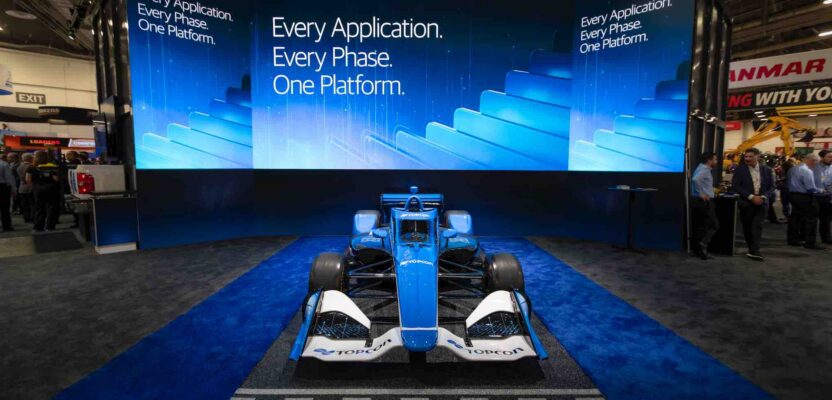
At ConExpo, some booths display products. Others project momentum. Topcon did both.

From the aisle, the scene was hard to miss. The booth was busy almost constantly, each kiosk crowded with a rotating mix of current customers, future customers, partners, dealers, and industry observers and media. Demonstrations ran continuously. Conversations layered over one another. Specialists moved quickly from one discussion to the next, answering technical questions, walking visitors through workflows, and translating product capabilities into practical outcomes. It had the feeling of a company in full stride—an all-hands performance in which executives, product teams, marketers, and technical staff were all visibly engaged. The energy was intense, but it was also focused. Topcon was not merely exhibiting. It was executing.
That atmosphere mattered because the company’s message at ConExpo was bigger than any single launch. Across a press briefing, a strategic conversation with Topcon President and CEO Ivan Di Federico, and a show-floor discussion centered on the new Origo system, one idea came through with unusual consistency: Topcon is not simply introducing more tools to the market. It is advancing a broader point of view about the future of construction. In that future, precision is not a premium feature or a specialist’s concern. It is the starting condition for layout, machine control, verification, digital twins, automation, and every workflow that depends on trusted spatial truth.

Di Federico expresses that idea through a phrase that, at first glance, sounds almost disarmingly simple: Precision exists.
But the more he explains it, the more it becomes clear that this is not a tagline in the usual sense. It is a first principle.
“Precision is where we start, not where we want to go or what we want to achieve,” he said.
That is at the heart of Topcon’s current strategy. In much of the construction technology world, precision is often framed as a goal—something to be approached, managed, or optimized depending on the job, the economics, and the capabilities of the equipment. Di Federico’s view is fundamentally different. Precision is not the finish line. It is the prerequisite. If the foundational measurement is weak, then every system built on top of it inherits that weakness. Reporting becomes less trustworthy. Machine control becomes less reliable. Digital twins lose authority. AI operates on unstable inputs. Rework becomes more likely, and operational clarity starts to erode.
“Data needs to be good,” he said during the ConExpo press briefing. “With the wrong data, the consequence is not only you have to rework, but you are put into a terrible crisis for your ERP systems, the way you manage your people, your resources.”
That line does a good job of explaining what Topcon was really presenting at ConExpo. Yes, the company arrived with a substantial portfolio of product news: new machine control options, cloud tools, robotic positioning, AI-driven safety systems, weighing solutions, and scanning technologies. But the deeper story was not the volume of announcements. It was the framework connecting them. Topcon is building toward a more disciplined construction environment in which trusted measurement supports better decisions all the way from field execution to enterprise visibility.

That ambition was visible not only in the formal presentations, but also in the way customers engaged the booth.
In a reserved customer area away from the main traffic, I asked one attendee a simple question: Why Topcon?
His answer came immediately.
“It just works,” he said. “They are easy to work with and if I need support or have any issue at all, they are there—always reliable.”
Then, taking another sip of his cold beer—perhaps not irrelevant to the warmth of the endorsement—he added, “Their software is easy to use, and I know the next piece of gear I acquire, that will be easy to integrate and that will work too.”
It was not a polished corporate sound bite. That was precisely what made it useful. In a straightforward way, he captured the value proposition Topcon was working hard to demonstrate across the booth. Customers are not only buying performance. They are buying confidence: confidence that the hardware will work, that the software will be usable, that the next system added to the fleet will integrate cleanly, and that support will be there when needed. In other words, they are buying reliability not as an isolated product trait, but as an ecosystem characteristic.
That ecosystem mindset runs through Di Federico’s perspective on innovation. He speaks of it not as performance or novelty, but as stewardship. In his view, the industry has entered a new phase—one in which the barriers to developing advanced technical capabilities have fallen dramatically. Sensors are more accessible, computing power is more abundant, software is more adaptable, and prototypes can be brought to life faster than ever before.
Yet that abundance introduces a different kind of challenge: discipline. The central question is no longer simply what can be built, but what should be built—and what can be supported responsibly over the long term. Every decision to bring a product to market carries lasting consequences. It creates obligations around training, service, spare parts, and customer support, often for a decade or more. It also shapes expectations across the broader industry.

As Di Federico noted, “The most effort needs to go to what does make sense to do and focus resources. Any decision we take into developing a product has consequences. That product I will need to support. I will need to train people about it. It’s with me for 10 years with spare parts and services. And it’s affecting the industry.”
For Di Federico, innovation is not just about expanding what is technically possible. It is about applying resources where they create enduring value—for customers, for partners, and for the market Topcon helps lead.
That is an unusually sober way to talk about a launch cycle, and it gives the Topcon story more weight. The company is not presenting innovation as an end in itself. It is presenting innovation as something that must earn its place by improving the way real work gets done.
It also helps explain why Di Federico speaks so directly about the fading boundary between geomatics and construction. For decades, the two domains have often been treated as adjacent but distinct—one rooted in high-confidence geospatial measurement, the other in the practical realities of building and field execution. Topcon’s position is that this divide is no longer sustainable.
“This division that we have in mind for some reason, between what is geo and what is construction, has to drop,” he said. “I don’t see any reason why construction should not be millimeter level. It is possible. And the Origo that you see on the show floor is a first effort to show the industry that these two things are the same, geospatial and construction is actually the same thing.”
That is a bold claim, and it makes Origo more than another product introduction. It makes it a statement piece.
On the surface, Origo is a layout solution. In strategic terms, it is one of the clearest expressions of what Topcon is trying to do: take advanced precision, reduce the complexity of using it, and embed it more naturally into the daily flow of construction work.
During the press briefing, Topcon described Origo as a world’s-first solution that uses sensor fusion and continuous environmental awareness to remove some of the most familiar constraints in layout—line-of-sight dependency, tripod dependency, and the constant burden of leveling and repositioning. “For the first time, we can think of a construction job site without a tripod, without line-of-sight issues,” Di Federico said.

On the show floor, the explanation became even more tangible. The product manager described traditional layout as a process burdened by “tethers”: tape measures, chalk lines, tripods, line-of-sight interruptions, and the constant act of “chasing the bubble.” Origo is designed to remove those tethers. It still relies on control points to orient the field to the model, but once that is established it creates a reference map of the surrounding environment and uses that map to maintain its position continuously. Those reference maps can be shared across multiple units, allowing additional crews to start work without repeating the entire setup cycle.
That is an important point because it shifts the product conversation away from novelty and toward workflow. Origo is not interesting simply because it looks different or because it avoids line-of-sight limitations. It is interesting because it changes how layout labor can be organized, how crews can work in parallel, and how much friction can be removed from a crowded job site.
It also changes what layout produces.
While an operator is using the system for layout, Origo is also collecting information in the background: scans of the environment, panoramas, stored points, reference maps, and comparisons between the model and real-world conditions. That information can flow into Topcon’s MAGNET Enterprise and Collage Web, where it becomes part of a larger digital record of what happened on site, when it happened, and where conditions may already be drifting out of tolerance.
This may be the most consequential aspect of the Origo story. It turns layout from a narrow field task into a broader documentation and verification workflow. The operator is not being asked to do additional work to create this value. The value is generated as part of the work already being performed.
For Di Federico, that is exactly the point. Once measurement reaches a certain level of precision and consistency, it becomes the substrate for a much wider set of capabilities.
“When you think of that and you have the fact that precision now at millimeter level is the texture over which you build all the rest, you can build twins. You can build maintenance programs. You can create as-builts. You can build artificial intelligence,” he said.
Seen through that lens, Origo is not simply a layout device. It is a visible proof of Topcon’s larger thesis: that precise, reliable, low-friction measurement should sit underneath more of construction’s operational and digital stack.
The rest of the ConExpo portfolio reinforces that message. Topcon highlighted 3D MC Edge as a more accessible path into 3D machine control, slope control for tilt-rotator-equipped excavators, hybrid lock across machine control solutions, the new GTS-M1 robotic total station designed for machine control, cloud-based site management, AI-enabled safety awareness, onboard load weighing, and an expanding family of laser scanning solutions.
Individually, those solutions serve different needs. Collectively, they reveal a consistent design logic centered on sensor fusion, operational connectivity, field usability, and trusted measurement. Topcon is not merely asking how the job site can be digitized. It is asking how digitization can become more dependable, more integrated, and more actionable.
That same logic extends to partnerships. Di Federico spoke candidly about Topcon’s more open posture toward working with specialized external companies where those relationships strengthen the overall system. The goal is not to chase every emerging capability internally. The goal is to integrate selectively where outside innovation helps extend resilience, usability, or performance while keeping Topcon focused on its core mission.
“We have changed that recently,” he said. “The world has changed, because there’s a number of companies that are specialized in things which would be difficult for us to replicate. Even though we could, there’s no reason.”
Still, even the strongest technical architecture does not guarantee adoption. In Di Federico’s view, adoption may be the hardest challenge of all. The real obstacle is often not a lack of capability, but a gap between what the technology is designed to do and what users can realistically understand, trust, and apply in the field. When that gap becomes too wide, even highly capable tools can struggle to gain traction.
“It has to be easy to operate,” he said during the press briefing, noting that a major share of engineering effort is now focused on simplifying the interface.
In the longer conversation, Di Federico made the point even more directly: adoption is not driven simply by price, or by making technology cheaper. It depends on whether people truly understand how to use it and how it fits into their work. That is why Topcon continues to invest in training centers, structured enablement, and a more disciplined release cadence designed to help customers absorb innovation in a steady, predictable way.
That commitment to enablement may turn out to be one of the most important parts of the entire strategy. The industry has seen plenty of tools that promised transformation. What it has seen less often is a company willing to treat adoption, training, and long-term usability as central to the value proposition rather than secondary to it.
Topcon’s ConExpo presence was not simply a product showcase, though it certainly succeeded as one. It was a live demonstration of a broader argument: that the future of construction will depend on making precision easier to carry into the field, easier to sustain across workflows, and easier to trust when the cost of being wrong is high.
Which brings the story back to the booth itself.
The crowds, the nonstop demos, the packed kiosks, the all-hands effort from every level of the organization—none of that felt accidental. It reflected a company trying to show that advanced precision does not have to remain abstract, intimidating, or isolated. It can be practical. It can be connected. It can be dependable. And for customers, that may be the most compelling message of all.
Why Topcon?
The answer heard in that customer lounge may have been the simplest and the best: because it works, because it integrates, because the support is there, and because reliability is never treated like an afterthought. For a company building its future around the idea that precision exists, that kind of trust is not adjacent to the story. It is the story.