
Category Archives: Cartography
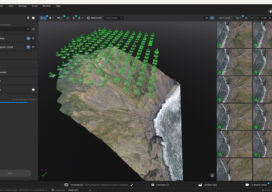
Pix4D’s Platform Moment: From Photogrammetry Engine to Enterprise Reality
Fifteen years into the UAV software revolution, Pix4D’s CTO sees Gaussian splatting, AI-assisted editing, and the smartphone-as-surveying-instrument converging into something bigger than any single tool. When Pix4D was founded in 2011 as a spin-off from EPFL’s Computer Vision Lab in Lausanne, the pitch was essentially this: drones are coming, and someone has to turn the...
The Image as Evidence
Time-stamped, location-aware imagery has quietly crossed a threshold from documentation to trusted record. The geospatial profession is now in the business of producing evidence — and the standards have not caught up to the stakes. A surveyor flying a bridge deck, a GIS technician cataloging post-storm damage, a mapping firm delivering obliques to an insurer:...
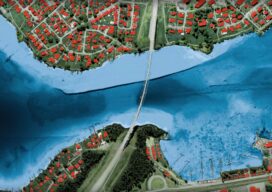
Seeing Through the Water: Inside Leica’s CoastalMapper
The new four-channel bathymetric sensor redefines what airborne hydrographic surveying can cover — and how fast Airborne bathymetric lidar has always been a physics argument. The physics are largely fixed: green laser light at 532 nanometers penetrates water in ways that infrared does not, but the water column itself attenuates the signal, and the degree...
Why 3D Fuels Modeling Is Now a Geospatial Problem
As wildfire planning demands better inputs, the challenge is shifting from data collection alone to how vegetation and surface fuels are measured, classified, and turned into model-ready 3D information. Wildfire is forcing a shift in geospatial thinking. High-resolution capture is no longer the finish line. The harder question is whether vegetation and surface-fuels data can...
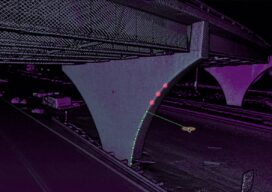
Between the Scanner and the Deliverable: How Mach9 is Building the Missing Layer in Geospatial Production
A Carnegie Mellon-trained roboticist who learned surveying in a coal mine and mapped uranium deposits inside decommissioning pipes is now building what he calls a new category of software — one that sits at the intersection of CAD, GIS, and the physical world. Alex Baikovitz did not set out to build CAD software. He set...

Brave New Coordinates: What NSRS Modernization Means for Survey and GIS Practice
NAD 83, NAVD 88 and “SPCS ’83” are finally giving way to a modern, GNSS- and gravity-based National Spatial Reference System. The technical pieces are arriving now. For surveyors and GIS professionals, the hard work will be managing the transition while keeping projects on track. For more than a decade, NOAA’s National Geodetic Survey (NGS)...