
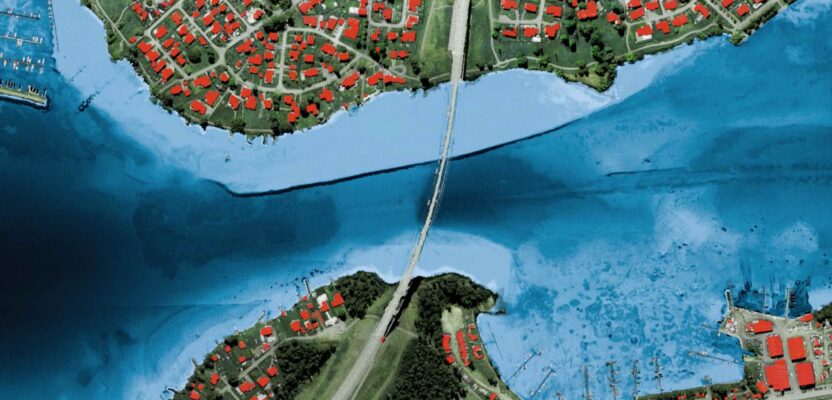
The new four-channel bathymetric sensor redefines what airborne hydrographic surveying can cover — and how fast

Airborne bathymetric lidar has always been a physics argument. The physics are largely fixed: green laser light at 532 nanometers penetrates water in ways that infrared does not, but the water column itself attenuates the signal, and the degree of that attenuation varies with turbidity, depth, seabed reflectance and surface state. Every engineer working in this field is solving the same fundamental set of constraints. What changes from generation to generation is how much of the performance envelope those constraints allow you to push — and how far you can shift the economics of doing so.
Leica Geosystems, part of Hexagon, announced the CoastalMapper in February 2025. By late that year, NV5 Geospatial had taken delivery of the first production unit at INTERGEO in Frankfurt, becoming the first operator in the world to deploy it. At Geo Week 2026 in Denver, xyHt sat down with Anders Ekelund, vice president of airborne bathymetric lidar at Leica Geosystems to understand what it is, why it was built the way it was, and what problems it is actually designed to solve.
The answer begins not with the product but with the operational problem that drove it.
The Efficiency Problem
The core design objective of the CoastalMapper was, as Ekelund described it, “to revolutionize the collection efficiency of bathymetric lidar data.” The target was ambitious: similar or better data quality than existing sensors, collected from a higher altitude and a wider field of view, with a resulting increase in survey efficiency of approximately 250 percent — two and a half times the area coverage per flight hour compared to previous-generation systems.
The system covers up to 360 square kilometers per hour, or roughly three square kilometers per minute — a figure Ekelund offered directly when asked about throughput. For context, that pace makes the CoastalMapper ill-suited for small, bounded projects. Surveying a single port or harbor, Ekelund noted, would be finished in perhaps ten seconds of productive flight time; the overhead of positioning, transit and setup would dwarf the actual collection. The system is designed for large-scale national collection programs, for coastlines measured in thousands of kilometers, for river networks surveyed on multi-year cycles. That is the application class that makes 250 percent efficiency gains operationally meaningful.
The practical consequences of that efficiency gain extend beyond throughput. Faster collection means fewer aircraft hours, which means lower fuel costs, lower crew costs and less time in the field. For a technology class where system prices run between $1.5 million and $3 million and where operating economics are central to whether operators can make the business case for large programs, those reductions matter directly.

Four Channels, One Aperture
The CoastalMapper is not a single sensor. It is, in Ekelund’s description, “four different sensors integrated” — a bathymetric lidar assembly with four distinct channels, a full topographic lidar, and two high-resolution cameras, all combined into one compact, helicopter-mountable pod.
The four bathymetric channels address the fundamental challenge of shallow water coverage: the nearshore zone, where water depth transitions from zero to several meters, is simultaneously the most economically and ecologically critical area to map and the hardest to do well. In a single-channel system, the receiver must either be optimized for maximum depth penetration, which can struggle in extremely shallow or turbid water, or tuned for near-shore performance, which limits deep-water capability. The CoastalMapper’s four-channel bathymetric module separates those functions.
There is a super-shallow channel, designed specifically for the very shallow water that Ekelund described as “typically the most difficult part to collect.” There is a shallow channel covering the broader near-shore zone. A deep channel adds depth capability beyond what the shallow channels can achieve. The fourth element is the near-infrared channel — and this is where the system introduces something genuinely new.
The NIR Innovation: Co-Aligned Green and Infrared
Standard bathymetric lidar uses a green laser (532 nm) to penetrate the water column and a separate infrared laser to return off the water surface, providing the reference needed to compute depth. In most architectures, those two beams are not co-aligned — they illuminate the scene from slightly different angles and at slightly different times.
The CoastalMapper changes this. “We have a near-infrared and a green laser pulse that is co-aligned simultaneously through the same optical aperture,” Ekelund explained. The result is that the NIR return and the bathymetric return are captured together, from the same geometry, at the same moment. That co-alignment improves the system’s ability to discriminate the land-water interface precisely, and — critically — it provides a more accurate measurement of the local water surface, which is the reference needed for water refraction correction.
This matters because refraction correction is not optional. It is the difference between trustworthy depth data and meaningless numbers.

The Refraction Problem
When a green laser pulse enters the water, it bends. Advanced refraction correction techniques based on Snell’s law account for the bending of the laser beam at the air-water interface. The physics is straightforward in calm conditions and on a flat surface. In the field, it is not.
Ekelund was direct about the magnitude of the error. “If we don’t refract, you get a 25 percent error,” Ekelund said. That is not a rounding issue — it means that for every 10 centimeters of true depth, an uncorrected system may report 12.5 centimeters. At modest depths that may seem manageable; at the depths relevant for charting, infrastructure assessment and flood modeling, it accumulates into errors that compromise the entire dataset.
The problem becomes considerably more complex in ocean environments, where wave action means the water surface is continuously variable. Even in calm sea conditions, the planar coordinate displacement error of the seabed point caused by sea surface waves may reach the meter level, and the depth coordinate displacement error can exceed 0.2 meters. Forward and backward scan passes see different wave states. Constructing an accurate water surface model that accounts for wave geometry in real time — across different branches of a river system, across multiple water bodies at different elevations — is one of the hardest algorithmic problems in the field.
Ekelund put it plainly: “In a river, you can have multiple water surfaces. You can have a branch of the river going there, and another branch there. You can have a sudden dam where you need to measure the water surface very accurately to do the correct water refraction correction and create this water surface model.” The co-aligned NIR channel in the CoastalMapper is a hardware response to that modeling problem — providing simultaneous, geometrically consistent surface reference data to feed those algorithms.
The Dynamic Range Problem
Beyond refraction, Ekelund singled out one technical characteristic of bathymetric lidar that sets it apart from topographic systems: the dynamic range of the received signal is extreme.
In topographic lidar, the return signal varies with surface reflectance, which in typical survey environments might range from roughly 5 percent (dark asphalt, water at nadir) to near-100 percent (white surfaces, retro-reflective targets). “It’s a factor of 20,” Ekelund said. In bathymetric lidar, the receiver must handle a signal that can vary by a factor of 60,000. That figure encompasses the difference between a strong specular return off a calm, sunlit water surface and a faint bottom return from a dark, turbid river channel at depth.
Designing a receiver that can faithfully capture both ends of that range without saturating on the bright end or losing the signal on the dark end is a hardware challenge that has no real equivalent in conventional topographic systems. It is also why the super-shallow channel exists as a distinct module: the geometry and signal characteristics of very shallow water — where the surface return and the bottom return are nearly simultaneous and the signal-to-noise environment is dominated by surface backscatter — are different enough from deeper water that a dedicated channel with different receiver tuning is warranted.
The dynamic range requirement means that suspended sediments, algae or other particles that scatter and absorb the laser reduce effective depth — a challenge that advanced laser systems with higher pulse energy and optimized wavelengths are designed to overcome.

Depth Penetration and the Kd Metric
Assessing depth performance in bathymetric lidar requires understanding the Kd coefficient — the diffuse attenuation coefficient of the water column, which characterizes how rapidly light is absorbed and scattered with depth. Ekelund was emphatic that how manufacturers specify Kd-referenced depth performance is not standardized, and that comparisons across systems require care.
“We use the diffuse attenuation because that’s a more mathematically correct method,” Ekelund said. “And we specify our systems at 15 percent seabed reflectance. Some others do it at 80 percent seabed reflectance. It’s very, very difficult to find places with 80 percent seabed reflectance.” That distinction is significant. A depth figure derived at 80 percent reflectance — achievable in white coral sand in a handful of locations on earth — is not comparable to one derived at 15 percent, which represents a far more typical seabed.
Against that standard, the CoastalMapper achieves a Kd max of 3.5 — between the Chiroptera-5’s Kd max of 3.2 and the HawkEye-5’s preliminary depth penetration of approximately Kd 4.4. Ekelund framed this directly: “The depth penetration is in between our Chiroptera-5 and the Hawkeye-5, even if we’re flying much higher altitude with much higher efficiency.” That is a meaningful engineering trade-off — the CoastalMapper sacrifices some of the extreme depth capability of the HawkEye line in exchange for the coverage rate and altitude flexibility that make it viable for large-scale national programs.
The CoastalMapper’s specification notes that data can be captured in significantly more turbid water up to approximately Kd of 1.0, even though the primary depth formula is valid between Kd 0.1 and 0.4.
Topographic Lidar and Imaging: The Complete Picture
Bathymetric data alone is not the deliverable. The shoreline, riverbank, floodplain and coastal upland must be mapped simultaneously and at equivalent quality if the dataset is to be actionable for the full range of engineering, planning and environmental applications.
The CoastalMapper addresses this by integrating Leica’s TerrainMapper-3 topographic lidar — the same lidar sensor used in the company’s CountryMapper, TerrainMapper, and the newly announced CityMapper-3 — directly into the pod. The system captures up to two million topographic points per second, in addition to one million bathymetric points. The result is a single-pass dataset with seamless land-water coverage at survey-grade accuracy across both domains.
Imaging is handled by a 250-megapixel RGB camera and a 150-megapixel near-infrared camera. Both incorporate forward mechanical frame and motion compensation — a feature Ekelund described in terms that make the operational benefit clear: “As the aircraft flies with a certain speed, for a normal camera you get image blur from the speed of the aircraft, but we are moving the sensor simultaneously as the image is captured. So we don’t have that in our camera systems.” The compensation allows the system to fly in lower-light conditions and even, Ekelund noted, to conduct night flights — delivering raw imagery with no motion blur from the outset rather than relying on post-processing to recover sharpness.
The combined imaging produces RGB imagery at 5-centimeter GSD and NIR at 7-centimeter GSD at common flying heights.
The Algorithm Layer
Hardware is not the whole story. Ekelund was careful to distinguish between what hardware iterations can change and what algorithmic development can address — and to explain how the two interact.
“Bathymetric lidar is hard,” Ekelund said. “It’s a continuous development — both hardware and algorithm development.” The company currently has around 40 systems operating in the field worldwide, giving it a continuous feedback loop from diverse water conditions, turbidity regimes and survey environments. “As soon as we get some feedback, we ask for raw data, and then we release that to everyone.” Algorithm updates propagate to the whole installed fleet, improving every system’s performance on the problems that field operators encounter.
Hardware development, by contrast, involves large, infrequent steps followed by extended periods of stability. The CoastalMapper’s four-channel design — particularly the super-shallow channel and the co-aligned NIR — creates hardware affordances that the software can exploit. Features in the super-shallow channel, Ekelund said, “will enable us to maybe use the algorithms better.” But the continuous work of refining wave models, improving water surface reconstruction, handling turbid-water edge cases and discriminating vegetation from seabed proceeds in software and is released iteratively regardless of whether hardware changes.
The certification process itself is rigorous. All sensors go through DO-160 standard testing for electromagnetic compatibility, vibration, temperature and shock — the aviation certification standard that applies to airborne equipment. Every unit is calibrated in production and then validated in actual test flights before delivery. Training documentation, operational procedures and legal compliance documentation accompany the hardware. Ekelund’s description of the development-to-release process was notable for its absence of shortcuts: the path from R&D to shipped product is long precisely because bathymetric lidar operates in environments where errors have real consequences.
Applications: Coastal, River, Environmental
The applications the CoastalMapper addresses are not new. Coastal erosion monitoring, infrastructure resilience assessment, hydrographic charting of shallow-water areas, seagrass and benthic habitat mapping — these have been bathymetric lidar use cases for years. What has changed is the economics of addressing them at scale.
Forty percent of the world’s population lives in coastal zones. Every piece of infrastructure in those zones — roads, ports, residential developments, utilities — is subject to flood risk that requires accurate, current bathymetric data to model. Ekelund’s description of the value was matter-of-fact: “Every infrastructure investment you do there, you need to make sure that you don’t have flooding events that can affect that.”
River mapping, however, emerged in the conversation as the application with the most active growth trajectory. Japan has operated the most systematic national river mapping program of any country — a program covering 120 rivers on multi-year cycles, with the most important rivers surveyed annually. The rationale is straightforward: with 130 million people concentrated behind mountain ranges in a country that receives frequent typhoon-driven rainfall, the economic and human cost of under-maintained river systems is extreme. Japan’s investment in river maintenance, Ekelund noted, exceeds its investment in road maintenance.
Japan’s 2011 earthquake was a turning point, demonstrating that airborne lidar bathymetry could survey vast coastal areas in short periods — a Japan Coast Guard demonstration covered disaster areas of the Pacific coast of northeast Japan in just eleven days following the disaster. The case for systematic, recurring airborne bathymetric surveys was established clearly in that episode.
That model is beginning to take hold in the United States. Ekelund referenced the 3DEP program and its expansion into hydrographic applications as evidence that river mapping is entering a phase of systematic investment domestically. The CoastalMapper’s operational characteristics — specifically its ability to fly at higher altitudes than previous-generation systems, which makes it viable for steep-sided river corridors where lower-altitude flight is operationally constrained — position it well for exactly that kind of program.
On the environmental side, Ekelund pointed toward applications that are just beginning to develop. A Bahamas sea grass mapping project — motivated by the area’s role as a shark nursery — represented, in his description, “a first step in that direction.” More consequentially, Ekelund described a government program oriented toward measuring the reduction of agricultural fertilizer runoff into coastal waters and tracking seabed vegetation recovery as a result. The monitoring requirement — demonstrating that investment in reduced fertilizer use is actually improving marine habitat — requires repeated, accurate spatial measurement at scales that drone-based systems cannot reach efficiently. It is the kind of problem that a 360-square-kilometer-per-hour sensor is designed to solve.
Scale, Cost, and the Right Tool
Not every problem needs the CoastalMapper. Ekelund was direct about this. For a port survey covering a few hundred meters of quay wall, the system’s throughput is disproportionate to the task. “Survey a port is like ten seconds,” Ekelund said. UAV-based bathymetric systems are more appropriate for those small, bounded areas — though they come with their own operational overhead of crew, airspace coordination and area limitation.
The CoastalMapper exists in the tier of problems where scale and cost-per-area matter decisively. At $1.5 to $3 million per system, it is a significant capital investment. But operators like NV5 — the first commercial customer — and Woolpert (identified by Ekelund as another key U.S. customer) are in the business of running large, repeating survey programs where the efficiency gain translates directly into competitive positioning. Covering more coastline per flight hour, delivering datasets faster and reducing the per-square-kilometer cost of bathymetric data is what makes national-scale programs economically viable.
Ekelund’s framing of that dynamic was straightforward: customers “make good money out of it.” That is the closed loop that justifies the technology’s position: expensive sensors in the hands of operators whose revenue model scales with coverage efficiency.
What Comes Next
Asked about the future of the application space, Ekelund identified environmental data products as the emerging frontier. Not just habitat monitoring, but fusing information from multiple sensors into products that directly answer regulatory and resource-management questions: sewage discharge detection, water quality proxies from combined spectral and bathymetric signals, vegetation recovery metrics tied to policy outcomes.
Those applications are not fully formed yet. They require customers — typically governments with mandates and budgets — who are willing to commission the work and build the analytical infrastructure to use the data. But the trajectory is visible. As Ekelund put it, “that’s something that will develop maybe over the next ten years.” The risk profile of not monitoring coastal and riverine environments is rising in ways that have a direct effect on infrastructure investment, insurance pricing and regulatory requirements. At some point, the investment in systematic measurement follows.
The CoastalMapper is designed to be the collection platform when it does. Three square kilometers per minute. Four bathymetric channels. Co-aligned green and NIR through the same aperture. DO-160 certified, ISO-compliant in manufacturing, deployable from a helicopter into steep mountain terrain. It is not a subtle instrument. It is a production-grade response to the scale of the measurement problem.