
What Endurance Racing Teaches Us About Precision, Performance, and Continuous Improvement
The sun sets low over the flat Florida horizon.
As daylight fades at Daytona International Speedway, the infield comes alive in a different way. Campers glow with headlamps and LED strips. Fans drift between trailers, timing screens, and television monitors. Some wake in the middle of the night just to check their phones—scrolling the Rolex leaderboard for real-time gaps and class positions. Others keep the broadcast on in the background, the sound of engines rising and falling like a pulse.
Then it gets surreal.
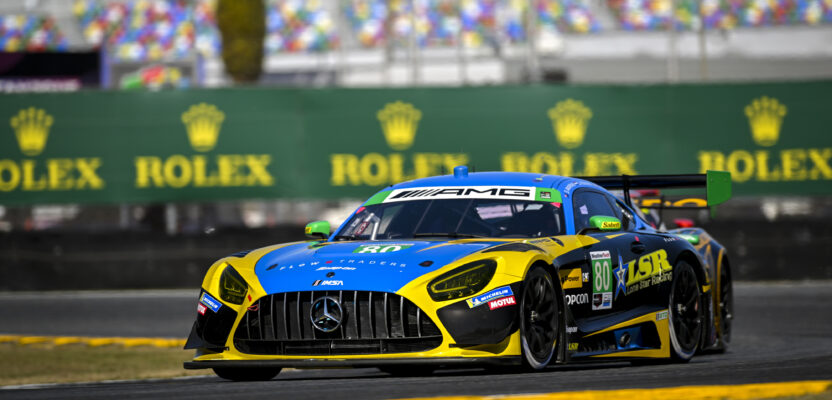
Cars reach 185 miles per hour in complete darkness, headlights compressing distance, braking points arriving sooner than instinct wants to allow. Every reference point is distorted by speed, fatigue, and traffic. Endurance racing is not about one perfect lap—it is about how long teams, machines, sensors, and drivers can operate cleanly under pressure without compounding small errors into race-ending failures.
This is where trust stops being an abstract concept.
At these speeds, at night, with limited visibility and relentless pace, trust becomes measurable: trust in the car, trust in the sensors, trust in the data, and trust in the decisions that follow.
James Roe Jr. calls it “trust at 165 miles an hour.”
For the surveying, construction, and geospatial industries, that phrase resonates more deeply than it might first appear.

A Platform Built on Precision—and Proving It
The IMSA WeatherTech SportsCar Championship has evolved into a proving ground where advanced vehicle platforms, dense sensor stacks, hybridized systems, and software-driven performance are tested under sustained competitive pressure. At the same time, the series’ visibility and stature continue to rise, with steady growth in broadcast audiences, streaming engagement, and trackside attendance, alongside broad and technically serious manufacturer participation. The paddock reflects a particular kind of credibility—brands associated with reliability, engineering depth, and long-horizon performance rather than short-term flash. For companies operating in results-based industries, where failure is costly and trust is earned over time, that environment matters.
It is this convergence of precision, performance, and credibility that makes motorsport such a relevant parallel for geomatics, machine control, and infrastructure development—and why James Roe’s relationship with Topcon has matured beyond sponsorship into shared philosophy.
Roe’s career spans multiple continents and competitive formats, from Daytona to Abu Dhabi, from endurance racing to Indy NXT. The tempo and structure change, but the demands do not: accurate measurement, correct interpretation, and decisive action under pressure. Across series, the discipline remains constant—and it is precisely that discipline that binds Roe’s racing career to Topcon’s approach to technology and execution.
From Sponsorship to Systems Thinking
Topcon has been involved in motorsports for six years—long enough for the relationship to mature beyond branding and into something operational. Over that time, Roe has become not just a driver representing the company, but a translator between two worlds that share more DNA than most people realize.
“There’s a natural crossover,” Roe explains. “In both motorsports and construction, it’s all about speed, accuracy, and performance. The language, the mindset—it’s remarkably similar.”
What makes Roe unusual is not just his ability behind the wheel, but his fluency in how performance is actually created (manifested, developed). He understands that winning—on a racetrack or on a jobsite—is not about heroics. It is about systems that hold up under pressure.
And in endurance racing, pressure is constant.

Good Data, Great Data, and the Difference That Matters
Modern race cars are saturated with sensors. Steering angle, brake pressure, damper movement, suspension travel, lateral and longitudinal G-loads—hundreds of channels streaming data in real time. Engineers watch it live. Drivers feel its consequences instantly.
But Roe is quick to draw a distinction that matters deeply to XYHT’s audience.
“The difference between good data and great data is huge,” he says. “Good data shows you there’s a problem. Great data tells you why that problem exists.”
He offers a simple example.
“You might look at steering data and see more steering angle than another car. That tells you there’s understeer. That’s good data. But why do you have understeer? When you start digging into roll stiffness, damper movement, spring rates—that’s when you find the root cause. Fix that, and the symptom goes away.”
This is not abstract analysis. It is a workflow.
On a jobsite, the same logic applies. A surface deviation, a grade inconsistency, a productivity slowdown—good data flags the issue. Great data enables correction without guesswork.
Trust is built not when data is merely accurate, but when it is actionable.
Trust at Speed and Trust Under Pressure
Racing compresses decision-making. There is no time for second-guessing.
“Trust is when you don’t doubt it,” Roe says. “You don’t question whether it’s calibrated. You don’t wonder if something was zeroed properly. You look at it, it makes sense, and you move forward.”
That mindset is instantly recognizable to experienced surveyors and machine control operators.
When systems are trustworthy, work flows. When they are not, everything slows down.
“At 165 miles an hour, you don’t have time to argue with the data,” Roe continues. “You either trust it, or you’re behind.”
That trust is not blind. It is earned through repeatability, consistency, and reliability under conditions that punish mistakes.

Results-Based Businesses Share the Same Physics
Roe describes motorsport bluntly: “It’s a results-based business.”
Budgets are finite. Testing is limited. Mistakes are expensive. Time lost is rarely recovered.
Those constraints mirror the realities of construction and infrastructure work almost exactly.
“Whether you’re racing or building, it’s time-based and cost-based,” he says. “A project finished early is usually a project in the green. A race finished cleanly puts you in position to win.”
This is where technology becomes more than a productivity tool. It becomes a risk-management instrument.
“In racing, if data helps us avoid an extra test day, that can save forty or fifty thousand dollars,” Roe explains. “On a jobsite, avoiding rework or downtime can be the difference between profit and loss.”
Trust in technology allows teams to operate closer to their limits without crossing them.
Continuous Improvement: Never Satisfied, Always Iterating
One of the most striking parallels between elite racing teams and top-performing contractors is an almost obsessive commitment to improvement.
“You’re never satisfied,” Roe says. “You can always be better. You’re only as good as your last race, or your last project”
That philosophy resonates deeply in geospatial workflows, where each project resets expectations. Previous success offers no guarantee of future performance. Conditions change. Variables shift. Equipment evolves.
“When you start seeing benefits from data and technology, it creates a runway,” Roe explains. “You want more efficiency, more consistency, more confidence.”
In both environments, technology does not replace skill, it amplifies it.
“You might be a great driver, or a great operator,” Roe says. “But someone else is always figuring something out. Having the right tools keeps you from falling behind.”

Smooth Surfaces, Fewer Variables
One area where the crossover between racing and infrastructure becomes tangible is surface quality.
Modern race cars operate extremely close to the ground. Small surface irregularities have outsized effects on grip, stability, tire wear and ultimately, confidence behind the wheel.
“When tracks are smooth, we can run the car in its optimal window,” Roe explains. “Drivers are happier. Engineers are happier. Lap times are better.”
That “window” has narrowed significantly in recent years, particularly as IMSA’s top classes have evolved toward aerodynamically efficient, ground-effect-influenced platforms. Rather than relying solely on large wings to generate grip, modern endurance cars increasingly use airflow management under the car—venturi tunnels, diffusers, and carefully controlled ride heights—to create downforce while minimizing drag.
The physics are unforgiving.
When a car is run lower and closer to the surface, downforce increases, tire contact patches become more consistent, and aerodynamic balance stabilizes across a lap. The payoff is measurable: higher cornering speeds, reduced tire degradation, and more predictable handling over long stints. Just as importantly, efficient downforce reduces overall aerodynamic drag, allowing cars to maintain pace while saving fuel. This is a decisive advantage in endurance racing, where strategy often hinges on stint length and pit timing.
But that performance envelope only works if the surface beneath the car is known, repeatable, and smooth.
At millimeter-scale ride heights, bumps, dips, and surface inconsistencies are no longer minor annoyances—they become destabilizing inputs. A slight deviation in surface profile can force teams to raise ride height as a safety margin, sacrificing aerodynamic efficiency and mechanical grip in the process.
“In endurance racing, you don’t just want outright speed,” Roe says. “You want speed that you can trust for hours at a time.”
This is where surface intelligence becomes inseparable from vehicle performance. A smoother, better-characterized track allows engineers to confidently run cars lower, maintain aerodynamic balance, and keep the vehicle operating in its most efficient state for longer periods. Drivers feel that confidence immediately. Not just in lap time, but in stability under braking, consistency through high-speed corners, and reduced fatigue over extended stints.
The broader trend inside IMSA reflects this reality. As the series has attracted more advanced platforms and manufacturer investment, precision has replaced tolerance as the governing principle. Cars are engineered to operate closer to theoretical limits, and those limits assume surfaces that can support them.
In that sense, racetrack surfaces are no longer passive infrastructure. They are active performance enablers, just like sensors, software, and aerodynamics. And the smoother and more predictable the surface, the more trust teams can place in the entire system.
For surveyors, engineers, and machine control professionals, the parallel is clear. Whether shaping a racetrack or a roadway, controlling surface quality is no longer about comfort alone. It is about enabling downstream performance, efficiency, and reliability in systems that operate ever closer to their limits.
Motorsport as a Trust-Building Environment
One reason endurance racing resonates with technical audiences is that it exposes weaknesses quickly. Systems that work only in ideal conditions do not survive 24 hours of sustained stress.
This is also why motorsports has proven to be an effective environment for engaging professionals from construction, surveying, and geospatial backgrounds.
“I didn’t realize how many motorsports fans work in construction or surveying until I started meeting them at races,” Roe says. “But it makes sense. These are performance-driven people. They care about precision.”
The connection is not about entertainment alone. It is about shared values: discipline, accuracy, and accountability.
A Global Lens on Performance
Roe’s racing calendar spans continents—North America, Europe, Asia, and the Middle East. Different cars. Different teams. Different environments.
“The common denominator everywhere is data,” he says. “Every time you get out of the car, you look at data.”
That global perspective reinforces a central truth: workflows must scale across conditions.
Whether operating in Florida humidity, European rain, or desert heat, systems must deliver consistent outputs. Trust cannot be location-specific.
That requirement mirrors the reality faced by global construction firms and survey organizations deploying technology across diverse environments.
Why Trust Is the Throughline
As technologies become more sophisticated at integrating GNSS, inertial sensors, software platforms, and automation, the limiting factor is rarely capability. It is confidence.
“You don’t get productivity unless you trust the data,” Roe says. “Once you trust it, you can really lean into it.”
At speed, hesitation costs time. On a jobsite, hesitation costs money.
Trust allows teams to act decisively.
Roe sees the future clearly.
“Everything is about streamlining workflows and using data to achieve better outcomes,” he says. “I’ve never seen good technology make someone’s life harder.”
That sentiment lands squarely in the geospatial world, where the best tools fade into the background, quietly enabling better decisions without demanding attention.
Whether chasing a checkered flag in the dark or delivering a complex infrastructure project under pressure, the principle remains the same:
Precision matters most when conditions are far from perfect.
At 165 miles an hour—or on a jobsite at dawn—trust is what lets performance scale.
And trust, once earned, becomes the most valuable asset any system can deliver.
Building Trust Into the Surface: How Topcon’s SmoothRide Helps Racetracks Become Predictable, Measurable—and Safer at Speed
At 165 miles an hour, “trust” is not a brand word—it’s a requirement. Drivers can’t second-guess what the car is telling them, and teams can’t afford uncertainty in the surface beneath the tires. For Topcon’s 3D paving group, that’s where SmoothRide becomes more than a technology story. It becomes a predictability story—trust you can literally drive on.
Sjoerd Stoové, Team Manager for 3D Paving at Topcon Europe, has spent nearly two decades in machine control and earthmoving, and now leads a specialist group focused on paving workflows, data handling, and SmoothRide execution support. “We didn’t have a support group for paving when it started,” he says. “It was emerging, so we stepped in as a paving team… and that team grew.”
SmoothRide was originally designed with roads in mind. But racetracks—where tolerances are unforgiving and consequences are immediate—became an ideal proving ground. “We took it to race tracks,” Stoové says. “What was nice about the race track is that we had a really demanding environment, and we could get the most out of our systems… We learned a lot that then trickles down in other projects, like airports and roads.”
The turning point came at Silverstone, where the track needed reshaping. Traditional approaches would have required marking countless depth changes across the surface—an error-prone process made worse by weather, night shifts, and compressed timelines. “At some places they needed to mill 14 centimeters, and at some places they needed to mill zero, and everything in between,” Stoové recalls. “In a traditional way… you will never be perfect.” SmoothRide’s differential milling approach was a match: the tool and the need met at exactly the right moment.
From there, the work expanded across major venues globally. Stoové’s team has supported projects at tracks including Silverstone, Spa-Francorchamps, Paul Ricard, Miami, Yas Marina, Singapore, and Shanghai, among others—each with different constraints, stakeholders, and performance goals.
But Stoové is clear: the real value is not simply the scan. It’s the trust created when multiple data sources, designs, and parties align. Racetrack and airport resurfacing often requires precise tie-ins to curbs, aprons, and transitions—details that can’t be handled by “XY only” thinking. “We figured out a way to connect the total station data from a survey and our scan data,” he says, so designs from track specialists can be validated against what was actually captured. The point isn’t perfection to a single millimeter everywhere. “What we’re looking for is consistency,” Stoové emphasizes—confidence that the model is reliable enough to drive decisions.
That matters because racecars don’t behave like road vehicles. “On a track, a race car is moving from left to right continuously,” he says. If cross-slope transitions aren’t consistent, drivers feel it immediately—especially at braking zones and turn entry, where small surface irregularities can become big problems.
Ultimately, Stoové frames the goal in terms that echo James Roe’s “trust at speed” theme. “We are the ones that keep guys like James safe,” he says. The end state is a surface that is “as smooth as possible” and, just as important, “as predictable as possible.” Predictability reduces compromise. It allows teams to run their preferred setup, push closer to the limit, and do it with confidence. And for the professionals who build roads, runways, and complex sites, the lesson translates cleanly: when the surface is measurable and the data is trustworthy, performance becomes repeatable.