
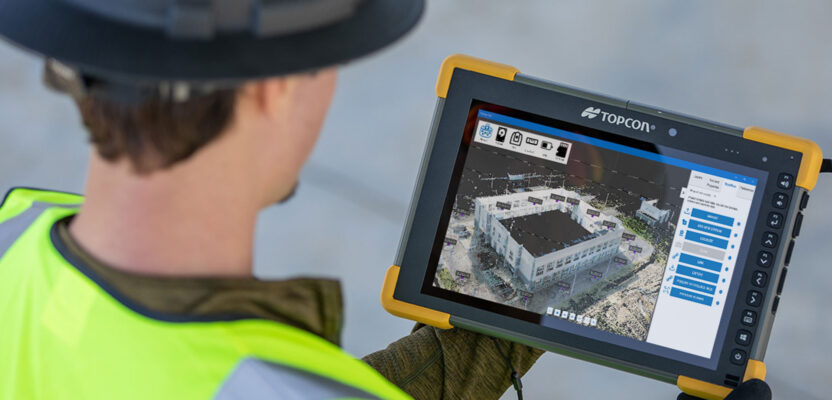
How Connected Workflows Are Redefining Geospatial and Construction Execution
Over the past decade, geomatics has shifted from a discipline defined primarily by measurement accuracy to one increasingly shaped by workflow execution. Sensors are more capable, data volumes larger, and project timelines tighter, while survey, GIS, and construction activities now routinely overlap. In this environment, the differentiator is no longer how precisely data can be captured, but how reliably it moves from field to office, and onward into design, modeling, and construction systems. Against this backdrop, Topcon 2.0 offers a useful case study in how geomatics is being operationalized for a workflow-driven market.
From Market Signals to Execution
Market shifts rarely announce themselves with clarity. More often, they emerge through changing customer priorities, evolving competitive behavior, and the expectations users bring to new tools.
Over the past year, Topcon’s activity across geomatics and construction has reflected those signals—not through a single announcement or headline product launch, but through a steady pattern of execution. The emphasis has been on tighter workflows, reduced integration overhead, and a clearer focus on how data progresses from capture to decision.
These signals extend well beyond Topcon-specific conversations. Across the industry, distributors and end users increasingly lead with questions about interoperability, activation complexity, and lifecycle support rather than raw sensor performance. Early discussions that once centered on accuracy or range now more often focus on how tools fit into existing processes and how easily they can be deployed across teams.
Ron Oberlander, Head of the Geomatics Platform at Topcon, characterizes the shift as one of refinement rather than reinvention. “We never left geomatics,” he says. “But Topcon 2.0 gives us a chance to step back into that space with fresh purpose—combining the DNA of our surveying legacy with tools designed for today’s reality-capture ecosystem.”
When the Topcon 2.0 framework was introduced, the intent was straightforward: reconnect the company’s measurement heritage with the realities of modern, data-driven workflows. That meant moving beyond standalone instruments toward systems that integrate positioning, sensing, processing, and delivery.
Today, that strategy is increasingly visible in practice. Across surveying, GIS, utilities, and construction environments, the focus has shifted toward repeatable performance—minimizing configuration effort, simplifying deployment, and sustaining availability under degraded conditions.
Oberlander describes the customer journey in deliberately simple terms: capture, process, model, decide. “That’s the workflow our customers expect,” he explains. “Our role is to make that seamless.”
The practical result is a portfolio organized less around product categories and more around operational outcomes. Hardware, software, and services are treated as interdependent components of a single execution environment.

Workflow as Infrastructure
At the center of this approach is a premise that resonates across the industry: users should not have to become system integrators to do precise work.
Surveyors, construction professionals, and field technicians already operate in dense information environments—managing point clouds, imagery, models, schedules, and designs under real-world constraints. In that context, the value of a technology stack is defined less by the sophistication of individual components than by how reliably those components work together.
Historically, much of the integration burden was pushed downstream. Users were expected to manage handoffs between tools, formats, and services, often at the point of delivery. The result was fragmented workflows and processes that were brittle under pressure. Topcon’s response has been to absorb more of that complexity upstream. The objective is fewer decisions in the field, fewer failure points between systems, and fewer opportunities for small issues to cascade into larger delays. The organizing principle remains consistent: simplify execution by reducing unnecessary steps across the workflow.
Resilience as a Baseline Requirement
Nowhere is this philosophy more evident than in how Topcon is addressing positioning resilience.
GNSS adversity is no longer exceptional. Urban canyons, tree canopy, RF congestion, interference, and mixed indoor–outdoor workflows are routine across both geospatial and construction projects. In many cases, unreliable positioning translates directly into downtime, rework, and schedule disruption.
What has changed is not only the frequency of these conditions, but their operational impact. When positioning interruptions occur on a modern jobsite, the cost is rarely isolated to a single user. Crews may be delayed. Machines may sit idle. Dependent workflows stall while problems are diagnosed and corrected.
Topcon’s response has been to treat resilience as a baseline requirement rather than a specialized feature. The goal is not to require users to manage positioning modes or signal sources, but to ensure consistent performance across environments.
“The users expect to have accurate position in any environment,” Oberlander notes. “and they just want it to work—consistently.”
Rather than relying on a single solution, Topcon is assembling a layered resilience strategy composed of complementary capabilities that can be applied as conditions demand.
Network corrections and positioning services, such as Topnet Live, are increasingly treated as integrated system capabilities rather than external add-ons. Historically, these services were often activated reactively or managed separately from hardware, introducing additional decision points into the workflow. Topcon’s recent approach reflects a shift away from that model, with capabilities designed to be present when needed rather than configured on the fly.
“We are simplifying the process to provide technology to our users,” Oberlander says. “If the capability is there, it will be available to use right away.”
As part of this broader resilience strategy, Topcon is collaborating with Fixposition, a specialist in Visual RTK and vision-aided positioning. Fixposition’s technology is well suited to environments where GNSS alone struggles—indoors, near structures, under canopy, or in visually rich but RF-challenged settings.
Rather than positioning vision-based techniques as replacements for GNSS, the collaboration reflects a pragmatic approach: augment positioning where it materially improves continuity and productivity. For many organizations, these conditions are no longer edge cases. Utility corridors, dense urban sites, and indoor–outdoor transitions increasingly define daily operations, creating demand for solutions that address present-day constraints without disrupting established workflows.
Extending this logic beyond immediate operating environments, Topcon’s engagement with Xona Space Systems, a Low Earth Orbit (LEO) PNT provider, introduces a longer-term dimension to its resilience strategy. LEO-based PNT offers materially stronger signal characteristics than traditional GNSS, with advantages that become significant in obstructed or interference-prone environments. While Xona’s constellation is still progressing toward initial operational capability, the partnership reflects more than a passive hedge. It signals Topcon’s view that LEO PNT will form an important layer in future positioning architectures.
Taken together, Topcon’s work with Fixposition and Xona reflects an architectural view of resilience—one that accepts the limits of any single modality and designs around them. Vision-aided positioning extends operational continuity at the edges, where GNSS performance degrades but productivity cannot pause. LEO-based PNT points toward a future layer of positioning infrastructure intended to strengthen availability and confidence as operating environments become more complex.
Rather than presenting resilience as a single feature, Topcon is assembling a positioning stack that blends GNSS, vision-based methods, and emerging space-based signals into a more robust whole.
From Geospatial Workflows to Construction Execution
For geospatial professionals—surveyors, GIS teams, utilities, and reality-capture specialists—the implications of this strategy are most visible in how tools are connected.
Handheld and terrestrial scanners, GNSS receivers, total stations, and imagery increasingly function as entry points into a shared data environment. Multiple datasets can be aligned, visualized, and processed together rather than reconciled through manual effort.
This directly addresses one of the most persistent sources of inefficiency in geospatial work: aligning data collected with different sensors, at different times, by different teams. Reducing the effort required to clean and contextualize that data improves turnaround time and deliverable quality.
Platforms such as Collage support this workflow by providing a common environment for managing diverse data types and moving results efficiently into CAD, BIM, and GIS systems.
“It’s not about the scanner by itself,” Oberlander explains. “It’s about how that data flows into the workflows and applications customer is already using.”
In construction environments, the same workflow philosophy takes on a different emphasis. Here, the challenge is maintaining a consistent digital thread across the jobsite lifecycle—from layout and machine control to verification, progress tracking, and handover. Positioning, scanning, and modeling are no longer discrete steps; they are interdependent components of execution.
Construction environments expose workflow weaknesses quickly. Time pressure is higher. More users interact with the data. Errors propagate faster and at greater cost. In this context, even small points of complexity can have outsized operational consequences.
Integration Without Burden
A defining aspect of Topcon’s approach is its long-standing commitment to open, mixed-fleet integration.
Most organizations operate heterogeneous environments that include legacy equipment, third-party sensors, and multiple software platforms. Rather than forcing consolidation, Topcon’s strategy has been to absorb complexity upstream, allowing users to operate downstream with fewer compromises.
This approach reduces retraining costs, avoids brittle workflows, and supports gradual adoption rather than forced transitions. Recent integrations—including workflows that combine above-ground and below-ground data through third-party GPR providers—reinforce this posture.
The emphasis is not on owning every component, but on making disparate data usable together.
Letting Execution Speak
Topcon 2.0 is not defined by a single launch or technology. It is defined by a pattern: simpler activation, stronger resilience, tighter workflows, and a willingness to integrate where it benefits the user.
For geospatial professionals, that pattern appears as faster paths from capture to insight. For construction teams, it shows up as continuity across the jobsite lifecycle.
In both cases, the signal is the same—not announced, but demonstrated.