

How a user-driven rethink of field–office connectivity, training, and cross-industry collaboration is changing the way surveyors, geospatial teams, and builders deliver work—on time, on spec, and at scale.
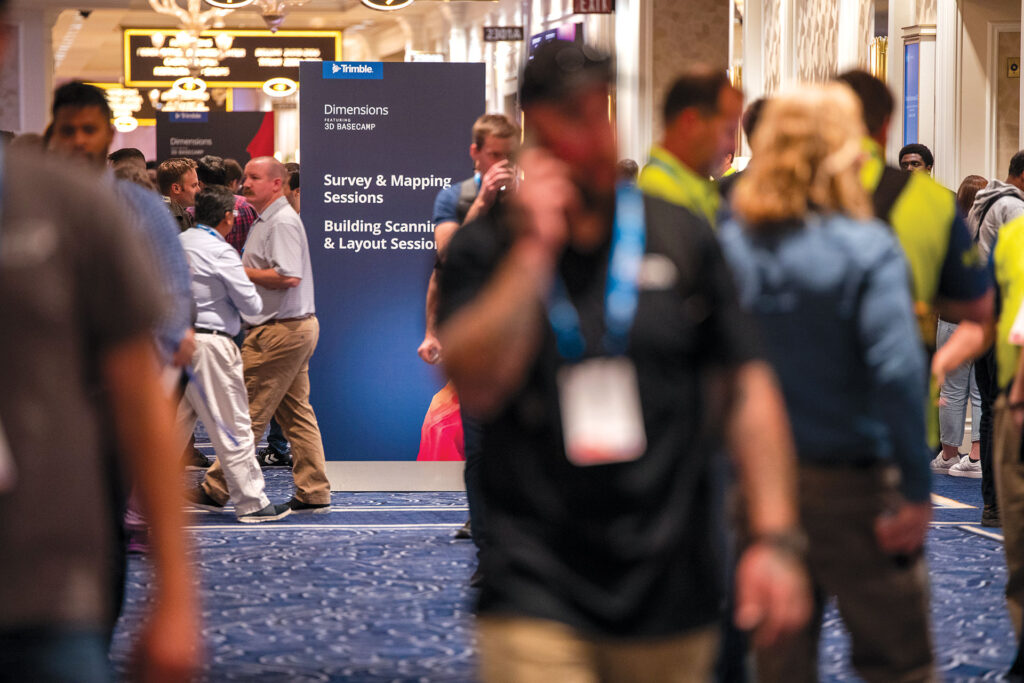
Trimble Dimensions has never been a passive showcase. It has always been an event where surveyors, contractors, geospatial professionals, and engineers collide with technology and leave with something tangible. But in 2025, the emphasis sharpens into something even more practical: workflow innovation.
That phrase captures not only what new products do, but what new practices make possible. Attendees in Las Vegas will not just walk the expo floor or sit in a lecture hall. They will experience how connected workflows shorten field operations, strengthen QA/QC, increase worker safety, and deliver authoritative data across industries ranging from utilities and power to mining, construction, and transportation.
From Hardware to Workflows
Derek Shanks, Director of Product Management for Trimble’s GNSS, optical instruments, radios, and accessories, has lived through every angle of this shift. Trained as a surveyor in New Zealand, Shanks cut his teeth on field software and later led system QA for the Trimble SX10 before moving into global product management in Colorado. For him, the message of Dimensions 2025 is that the days of evaluating hardware in isolation are over.
“People don’t work with a GNSS rover or a robotic total station in a vacuum,” Shanks said in our discussion. “They work to deliver a road corridor, a subdivision, or a utility mapping project. When they understand how the hardware, the field software, the office platform, and the collaboration layer all fit together, that’s when the efficiency gains become real.”
Shanks has spent the last three Dimensions conferences on the expo floor and in the classroom, explaining not just what new hardware does, but how it works and why that matters. He is clear about the need to demystify engineering details. Temperature sensitivity, IP ratings, or tilt behavior might sound abstract in a slide deck, but they translate directly into field accuracy and crew productivity.
“When you know why the instrument reacts a certain way, you don’t fight it—you work with it,” he said. “That’s not just optimizing settings but rethinking how people engage with the system in the first place.”

The Industry Track: Cross-Pollination by Design
If Shanks represents the product-side anchor, Gareth Gibson brings the global, industry-specific view. Based in Christchurch, New Zealand, Gibson serves as Trimble’s Industry Director for Utilities while also overseeing the mapping and GIS business. At Dimensions 2025 he curates the industry track, which intentionally blends case studies from a range of industries including utilities, transportation, fabrication, and mining.
“The whole point,” Gibson said, “is that workflow innovation doesn’t happen in a silo. A reality capture practice pioneered in civil infrastructure may be exactly what a manufacturing manager needs to scan a congested factory floor. A surveying workflow in transportation can influence how utilities handle asset records. Those adjacencies are powerful.”
Gibson pointed to one flagship example from the session catalogue: Blum Construction, which used Trimble systems to execute a complex hospital utility project. The motivation was clarity and collaboration. Using augmented reality for real-time 3D model visualization enhanced stakeholder decision-making and streamlined coordination on a critical infrastructure job. Similarly, American Electric Power has scaled Trimble Connect across more than 2,000 users, coordinating design to avoid clashes before construction begins.
“The real innovation,” Gibson emphasized, “is making invisible assets visible and usable to the most people as easily as possible.”
For surveyors accustomed to working within defined professional boundaries, Gibson’s invitation is clear: step into sessions outside your lane. Learn how a mining contractor approaches haul-road optimization, or how an electric utility enforces data governance. The workflows may differ in detail, but the underlying principles—connected capture, authoritative modeling, and common data environments—apply across the board.

Mining, Tunneling, and the Push to Autonomy
Riley Smith, Industry Director for Mining, Tunneling, and Monitoring, underscored that point from his vantage in Westminster, Colorado. Mining and tunneling may sound far afield from land surveying, but they increasingly share geospatial DNA.
“We’re seeing the civil side of mining,” Smith explained. “Where the old mindset was simply ‘dig and haul,’ operators are now applying civil-engineering principles to road curvature, underground navigation, and machine routing. That shift is driven by two things: geopolitics, which push countries to exploit resources more carefully, and the energy transition, which demands efficiency and sustainability.”
In practice, that means reality capture is no longer just for calculating volumes. It is for engineering infrastructure that keeps people safe and machines efficient, particularly as autonomy scales. Survey-grade geospatial context has become non-negotiable.
Smith described sessions where mining contractors from North and South America will present how they use Trimble reality capture and office processing not only to track material movement but to design infrastructure that supports autonomous haul fleets. “As autonomy spreads,” he said, “the margin for error shrinks. You need centimeter-level data feeding directly into machine guidance and safety envelopes.”
For surveyors outside mining, the lesson is not about commodities. It is about using geospatial workflows to engineer operations, not just document them.

The Data Bottleneck: AI for Pragmatic Insight
Both Gibson and Smith highlighted the same pain point: the bottleneck is no longer in data capture but in turning oceans of points and pixels into decisions.
Smith said, “We’ve been capturing enormous amounts of data for years, but the industry hasn’t been efficient at converting that into insight. AI’s pragmatic role is to extract what matters—road markings, utility features, signs, cabinets—and let professionals move from pixel-pushing to decision-making.”
This is not AI as hype, but AI as workflow accelerator. In the sessions Smith curates, surveyors will see demonstrations of automatic feature extraction from point clouds and imagery, followed by QC loops in Trimble Business Center (TBC), and then seamless distribution through Trimble Connect. The goal is not just fewer hours at the workstation, but cleaner, faster deliverables for clients and regulators.
Joe Blecha, Marketing Director, Office Software, confirmed the hunger for this capability. “Every year we expand our labs, and every year they fill,” he said. For Dimensions 2025, TBC has programmed 91 hours across 27 sessions, ranging from fundamentals to advanced labs on training custom deep-learning models for feature extraction. The message is clear: surveyors want to control their data destiny, not wait for magic buttons.
Field Software as the Window to Workflows
Stephanie Michaud, Director of Product Management for Field Software, keeps the loop anchored at the point of capture. Her remit is to ensure the connection from instrument to office to cloud is reliable every hour of every day.
“Our job is to build the window into the hardware innovations,” Michaud told me. “That means a surveyor or utility crew can capture GNSS, total station, or scan data, see it live in context, and know it will synchronize with the office.”
For Michaud, context is everything. Not every user needs every metadata field on screen. A locator cares about horizontal and vertical accuracy; a layout crew cares about orientation and model reference; a survey manager wants audit trails and QA/QC. Field software must surface the right detail at the right moment while preserving all information for traceability.
She pointed to Trimble Access pulling in live map services (WMS) so crews see authoritative context without fumbling with stale background files. “The less the software gets in the way, the more confidence people have in the workflow,” she said.
That workflow continues seamlessly into TBC for QA/QC, adjustment, and deliverables, then into Trimble Connect for sharing. The key is that the field team never has to wonder which version is current. Connected software keeps everyone aligned without version roulette.

Dimensions as a Training Event
Michaud emphasized the sheer scale of hands-on computer labs at Dimensions. Half of the conference rooms at peak times will be devoted to labs, with eight parallel rooms running. Many sessions are accredited for Professional Development Hours (PDHs) through NSPS, allowing surveyors to log continuing education while practicing workflows.
This scale matters. Dimensions is not a passive trade show. It is becoming a training event where attendees leave with credit hours, new workflows, and muscle memory in TBC, Access, Connect and related platforms. The most popular sessions are no longer feature demos, they are workflow labs, where practitioners follow along on laptops and apply new practices to real datasets.
That training extends beyond formal labs. Ask-the-Expert sessions allow one-on-one troubleshooting with product teams. Networking sessions bring together practitioners by industry to compare notes. And panels let multiple voices debate how AI, BIM, or utilities safety should evolve.
In short: the conference is structured to teach in multiple formats—classroom for depth, labs for practice, expo for hands-on, and networking for peer learning.
The Expo as a Living Lab
For field and office teams, the expo is the working lab where ideas meet reality. Attendees can walk from a classroom to a kiosk and try the feature they just heard about, often with the engineer who built it standing nearby.
The expo floor is staffed not by sales reps but by product managers, developers, QA engineers, and support staff. That makes it a two-way street: attendees gain technical depth, and Trimble’s teams gather unfiltered feedback.
Shanks has run “behind the scenes” sessions in past expos, showing how total stations are tested for environmental durability, why rod height matters, and how tilt compensation evolved. “When you understand how something works, you get more out of it,” he said. That transparency is essential to building trust.
The expo also houses cross-industry zones: civil construction, building construction, GIS, and utilities, all represented. For surveyors who serve multiple client types, this is a chance to understand downstream needs and adjust deliverables accordingly. It’s not just about survey gear. It’s about the ecosystem surveyors serve.
The Common Data Environment as Backbone
Across conversations with SMEs, a constant kept resurfacing: Trimble Connect as the collaboration backbone. Michaud called it the glue; Gibson called it the fabric. Whatever the metaphor, the point is clear: a common data environment (CDE) ensures that the latest control, design, or surface model is always what field crews and contractors reference.
Connect is what makes model-based field staking real. Rather than working from exported files, crews stake directly from the same approved design the engineer sees. Updates publish back to Connect so the office always knows the current state. This is data governance built into daily practice—workflow innovation made practical.
Customers and Engineers in Dialogue
Perhaps the most striking element of Dimensions is cultural. Across product lines and industry sectors, SMEs returned to the same idea: the conference puts customers on stage and engineers in the booth.
Blecha phrased it simply: “It’s more powerful to hear a user tell the story than a vendor.” Gibson emphasized that the best workflows emerge when customers compare across industries. Shanks stressed that Trimble’s own teams learn as much as they teach.
The result is a feedback loop: customer voice to product team, product team back to customer practice. That is why Dimensions has become more than a conference. It is effectively product development in public, with surveyors and geospatial pros directly shaping the tools they use.
Why It Matters Now
Why devote this much energy to workflows? Because the pressures on survey and geospatial firms are intensifying.
Labor shortages mean crews must become productive faster. Liability pressures mean every deliverable must stand up to scrutiny. Lifecycle demands mean models must serve not just design and construction but ongoing operations.
Workflow innovation—connected capture, contextual field software, pragmatic AI, authoritative office tools, and CDE-driven collaboration—is the lever that addresses all three. It reduces the training curve, strengthens auditability, and extends the value of data across the asset lifecycle.
That is the value proposition of Dimensions 2025: not a collection of features, but a repeatable plan your team can implement the Monday after Las Vegas. It is about a living digital ecosystem where surveyors, geospatial professionals, utilities engineers, miners, and contractors learn from one another and leave with workflows they can use immediately.
As Gibson put it, the goal is a “living, breathing digital twin” that connects office and field in real time. As Michaud stressed, no one works with technology in isolation; everyone has a deliverable in mind. As Smith underlined, AI is not a gimmick but a tool to shorten time-to-insight. And as Shanks and Blecha confirmed, the best way to get there is through open dialogue, training, and hands-on engagement.
Dimensions 2025 is that dialogue at scale.